Tax season doesn’t have to feel like a scramble. Whether you’re a W-2 earner juggling multiple income streams or a small business owner managing your own taxes, getting organized now sets you up to file your taxes with confidence come April 2026.
This guide walks you through everything you need to prep for taxes covering the 2025 tax year. The IRS typically opens e-filing in late January 2026, with the standard deadline of April 15, 2026. Extensions push filing to October 15, 2026—but payments remain due April 15 to avoid penalties. Early preparation means fewer errors, faster refunds, and less money left on the table. Let’s break it down into manageable checklists.

Get Ready to File: Your Core Tax Prep Checklist
Start here. This tax documents checklist gives you immediate action items:
- Create a 2025 tax folder (both physical and digital) to centralize all documents
- Confirm your filing status (single, married filing jointly, head of household, etc.)
- Locate last year’s tax return (your 2024 return filed in 2025) for reference and carryforward items
- Note key form deadlines: W-2s and most 1099s must be mailed by January 31, 2026
- Expect brokerage delays: 1099-B and consolidated statements often arrive in February or early March
- Build a simple timeline from January document collection through April filing
For small business owners:
- Sole proprietors and single-member LLCs file Schedule C with Form 1040
- S corporations file Form 1120-S, typically due March 15, 2026
- Consider a pro forma 2025 return with your tax professional to reveal projected liability before year-end
Gather Personal and Family Information
Accurate personal details prevent processing delays that affect 20-30% of filings with SSN mismatches. Collect these items for everyone on your federal income tax return:
- Full legal names exactly as they appear on Social Security cards
- Social Security number or ITIN for you, your spouse, and all dependents
- Dates of birth for all individuals claimed
- Current mailing address and email for IRS notices
Dependent documentation:
- Children under 17 for the child tax credit (up to $2,000 per child in 2025)
- Full-time college students under 24 for education credits
- Qualifying relatives you support over 50% without exceeding gross income thresholds
For your refund:
- Bank account routing numbers and account numbers for direct deposit
- National average refunds run approximately $2,800—get yours faster with direct deposit
Organize Your 2025 Income Documents
Every source of income from January 1 through December 31, 2025, must be captured—whether or not you received tax forms. Unreported income triggers IRS automated notices in 40% of cases.
Wages and salary:
- 2025 W-2 from each employer (federal/state withholdings, tips, allocations)
- 1099-NEC for contractor payments over $600
- 1099-MISC for rental income, prizes, and miscellaneous income
Investment income:
- 1099-INT for interest income from banks (taxable even under $10)
- 1099-DIV for dividend income and qualified dividends
- 1099-B for capital gains/losses on stock and ETF trades
- Consolidated brokerage statements reconciling all trades
Self employment income and business income:
- 1099-K for third-party payments exceeding $600 from platforms like Uber, DoorDash, Etsy, Shopify, or Upwork
- Track income independently if amounts fall below reporting thresholds—you still owe taxes
- Records for any side gig or online marketplace earnings
Rental property and farm income:
- Rental income and expense records for Schedule E
- 1099s from property managers
- Schedule F records: 1099-G for subsidies, 1099-PATR for cooperatives, crop and livestock sales
Other income sources:
- Social Security benefits statements
- Unemployment compensation (Form 1099-G)
- Gambling winnings, jury duty fees, or other records
Collect Records for 2025 Deductions and Credits
Organized records unlock an average of $1,500-3,000 in additional savings per filer. Don’t leave money on the table.
Itemized deductions (Schedule A):
- Mortgage interest statements (Form 1098)
- Property tax bills paid in 2025
- State and local taxes (SALT capped at $40,000 under recent tax laws)
- Charitable contributions and charitable donations over $250 with dated receipts
- Sales tax payments via IRS tables or receipts
Common tax deductions for self employed:
- Home office expenses (square footage logs)
- Business mileage at 70 cents per mile (maintain odometer logs)
- Professional development and required equipment
Tax credits (dollar-for-dollar reductions):
- Child tax credit documentation
- Dependent care credit: daycare statements with provider name and EIN (up to $3,000/$6,000 in expenses)
- Earned income tax credit for qualifying filers (up to $7,830 for three or more children)
- American Opportunity credit: Form 1098-T and tuition receipts (up to $2,500 for first four college years)
- Lifetime Learning credit for continuing education
- Student loan interest deduction (Form 1098-E)
Health-related items:
- Form 1095-A for Marketplace coverage and premium tax credits
- Health savings account contributions (Form 5498-SA, limits $4,150 individual/$8,300 family)
- Out-of-pocket medical expenses exceeding 7.5% of AGI
Retirement and education savings:
- Form 5498 for IRA contributions
- 401(k) contribution records from pay stubs
- 529 plan contributions (up to $18,000 gift tax-free)

Track Taxes You’ve Already Paid in 2025
Accurate records of tax payments prevent overpaying when filing your year’s tax return.
Payroll withholding:
- Federal and state income tax withheld per W-2 and 1099 forms
- These auto-populate but verify accuracy
Estimated tax payments:
- Q1 2025: Due April 15, 2025
- Q2 2025: Due June 15, 2025
- Q3 2025: Due September 15, 2025
- Q4 2025: Due January 15, 2026
- Retain all payment confirmations (EFTPS receipts, bank records)
- Safe harbor: Pay 100%/110% of prior-year tax or 90% of current-year to avoid 0.5% monthly penalties
Other payments:
- Prior-year 2024 balance-due payments made in 2025
- State and local taxes estimated payments
- Any fees paid to tax preparation services
Use Digital Tools and Simple Systems to Stay Organized
Digital organization during 2025 saves hours when you file in early 2026. Experts estimate a 70% reduction in reconstruction time for organized filers.
Folder structure:
- Main folder: “2025 Taxes”
- Subfolders: Income, Deductions, Credits, Business, Receipts
- Parallel paper folder for physical documents
Financial tracking:
- Use budgeting apps or bookkeeping software that exports 2025 year-end reports (PDF or CSV)
- Sync with QuickBooks or similar for easy Schedule C exports
Receipt management:
- Scan or photograph paper receipts from 2025
- Name files clearly: “YYYY-MM-DD_Vendor_Purpose.pdf”
- Organize by month for easy retrieval
Year-long logs:
- Maintain spreadsheets for mileage (odometer start/end), home office use (utility allocation), and business expenses
- Update quarterly rather than reconstructing everything in March 2026
Free tax help options:
- IRS Free File for AGI under $89,000 (eight partner software options, some include state returns)
- VITA and Tax-Aide provide free tax counseling and tax preparer services for qualifying taxpayers, and many business owners also benefit from virtual assistant support during tax season to stay organized and compliant
How a Virtual Assistant Can Simplify Tax Season
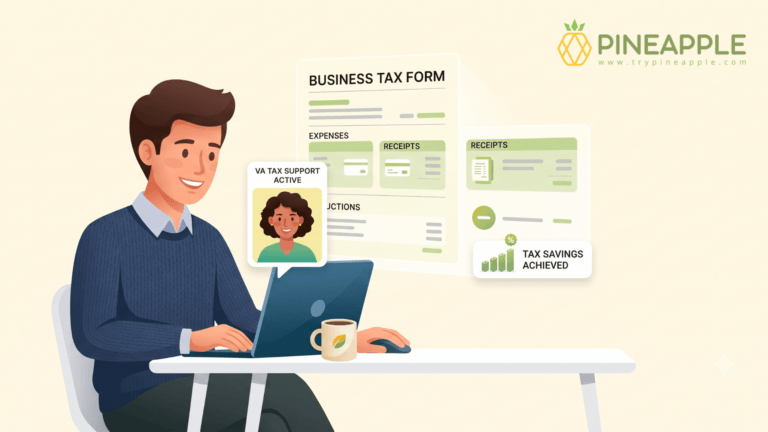
A dedicated virtual assistant can handle the administrative burden that makes tax prep overwhelming—especially for busy founders, freelancers, and business owners juggling multiple income streams who need virtual assistants to make tax filing easy for small business owners.
Document management:
- Request missing 1099s and W-2s from clients, vendors, and platforms
- Sort documents into categorized folders with standardized naming
- Compile expense summaries for your tax pro or tax professional
Deadline and calendar support:
- Set reminders 30 days before estimated tax due dates
- Track the April 15, 2026 filing deadline
- Schedule and confirm meetings with your CPA or enrolled agent
Ongoing organization:
- Maintain up-to-date client and vendor lists in CRMs
- Archive tax-related emails via filters for easy retrieval
- Ensure other records and required documents are accessible
Real impact:
- Freelancers and businesses with multi-streams see up to 50% reduction in CPA handoff time
- Fewer amended return filings (25% of filers amend due to disorganization)
- Reduced cost and additional fees from rushed in person appointments, especially when you monitor your virtual assistant’s productivity with clear systems and expectations

Why Our Virtual Assistants Are the Best Partner for Your Tax Prep
If you’ve read this far and feel overwhelmed, you’re not alone. Tax preparation demands consistent attention throughout the year—something most founders simply don’t have bandwidth for, which is often one of the signs you’re ready to hire a virtual assistant.
That’s where we come in.
Our virtual assistants are trained specifically for U.S. tax timelines covering the 2025-2026 season. They understand the deadlines, the forms, and the organizational systems that make filing seamless, similar to our broader Business Virtual Assistant® services that support operations beyond tax season.
What sets us apart: before you dive in, it’s worth understanding the broader benefits of hiring a virtual assistant for your business so you can match our services to your highest-value tasks.
Challenge | How We Help |
|---|---|
Documents scattered across email, drives, and paper | We create and maintain organized folder systems year-round |
Missing 1099s and W-2s at filing time | We proactively request forms from vendors and platforms |
Last-minute scrambles in March/April | We ensure everything is e filed ready weeks before deadlines with the right types of virtual assistants aligned to your workload |
| Complex multi-income tracking | We categorize self employment, rental income, and investment income systematically | | Accountant collaboration | We prepare summaries that reduce billable hours with your tax preparer and can start by guiding you through our tell us your needs matching process |
Ready to make this your smoothest tax season yet?
Schedule a consultation to learn how our virtual assistants can keep you prepared, compliant, and confident—not just for 2025-2026, but every tax year ahead. Whether you’re a founder, a stay-at-home parent exploring VA work for stay-at-home moms, or a law firm needing virtual paralegals and legal secretaries, our team can help. Focus on growing your business. We’ll handle the tax prep.