
Working with a virtual assistant is one of the most effective business solutions for increasing productivity, but it also has its own challenges, such as keeping track of performance. You, as the business owner, must utilize quantifiable metrics to best assess your virtual assistant’s productivity and manage their workload.
Many businesses rely on time tracking tools and project management tools to monitor remote work, particularly once they recognize the key signs that it’s time to hire a virtual assistant. A time tracker is a user-friendly solution that helps you see how a virtual assistant works by recording their work hours, activity levels, and productivity. Choosing the right tool is essential—it should be easy to use, quick to set up, and user-friendly, especially for virtual assistants. Tracking virtual assistant hours improves transparency and accountability in remote work environments. Time tracking software can also automate important but repetitive processes like attendance and time-keeping. Accurate time tracking allows businesses to bill clients correctly based on actual hours worked by virtual assistants.
So here are some tried and tested techniques and bonus tips for monitoring your remote team, building on the broader strategies we share in our virtual assistant insights and tips blog:
Introduction to Virtual Assistants
Virtual assistants have become indispensable partners for businesses, entrepreneurs, and professionals looking to streamline their operations and boost productivity. These independent contractors offer a diverse range of services, from managing emails and scheduling appointments to handling social media, bookkeeping, and data entry, and they can specialize across many different types of virtual assistant roles. As remote work continues to rise, virtual assistants are playing a crucial role in helping businesses stay organized and efficient, no matter where their teams are located, especially when they partner with a dedicated virtual assistant hub like Pineapple for trained Filipino professionals.
To get the most out of your virtual assistant, it’s essential to implement effective systems for monitoring and managing their work, starting with a strong hiring foundation through a matching process that pairs you with the right virtual assistant. Time tracking tools and project management tools are invaluable for keeping tabs on work hours, ensuring accurate time tracking, and managing billable hours. By leveraging these digital solutions, businesses can maintain transparency, optimize project management, and ensure that every hour worked is accounted for—making remote work not just possible, but highly productive, especially when paired with transparent, flat-rate virtual assistant pricing that makes budgeting straightforward.
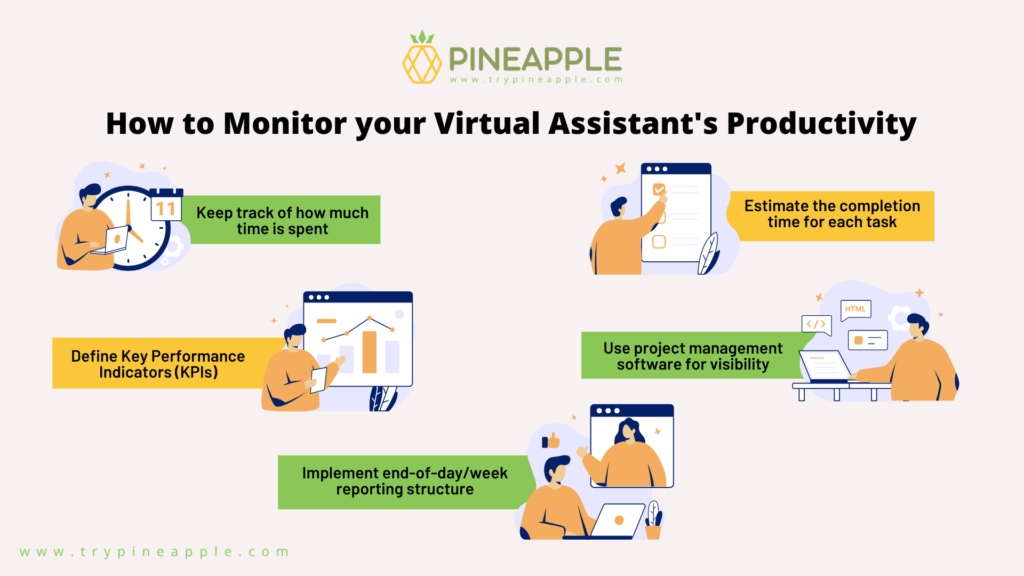
1. Keep track of how much time is spent with time tracking tools
Online time tracking tools are available to help employers keep a record of how much time their staff spends on various tasks. A time tracking app can provide detailed insights and activity tracking for both employers and virtual assistants, helping to monitor productivity, ensure efficient time management, and improve project oversight without invading privacy. It can provide reliable information on the number of hours your virtual assistant has put in against the tasks performed or the output produced, especially when combined with ongoing support from a dedicated Business Virtual Assistant® for administrative and operational tasks.
At Pineapple, we use a specialized tool to monitor virtual assistants and see how they spend their time while clocked in. Time Doctor comes with advanced features that can track the number of hours spent each day. It also periodically take screenshots to monitor what your virtual assistant is doing and determine whether your staff is actively working. It identifies screenshots with low activity by recording the number of keyboard strokes and mouse movements. So you’ll be able to see when someone is slacking off. Employee timesheets generated by digital time tracking tools should include clock in or out hours, breaks, absences, holidays, and time-offs to ensure comprehensive oversight and accurate reporting. Good time tracking software should also allow users to correct their time logs if they forget to turn on the tracker, reducing manual input errors and maintaining accurate records.
2. Estimate the completion time for each task
Along with keeping track of progress, it is also essential to have clear expectations in terms of completion time for each task. Productivity insights and productivity analysis from time tracking tools can help refine task estimates and improve workflow. Regular reports from time tracking tools can help identify weak points and areas for improvement. Therefore this way you can establish a productivity benchmark. Your estimate may be excessively high or extremely low, but you can still improve it over time. If you are unsure where to start, your virtual assistant will be able to help you better measure the reasonable deadlines. For they come with their own experience as experts in their respective fields.
3. Define Key Performance Indicators (KPIs)
One issue with measuring productivity is that each task has its own standard of success. Your team may consist of individuals who handle lead generation, write blog entries, create social media content, or perform Search Engine Optimization (SEO), along with many other tasks you can assign to your virtual assistant. It makes no sense to compare them all using the same productivity measures. Therefore, you will need different KPIs for each role.
Here are some ideas to help you get started:
Lead Generation – Number of leads, number of booked calls, and conversion rate, which are especially important if you work with real estate virtual assistants focused on prospecting and follow-up
Content Writer – Number of blog posts published, reach and engagement, number of leads generated from your call-to-actions (CTAs)
Search Engine Optimization – Organic traffic created, search visibility and ranking, bounce rate or percent of site visitors who didn’t take any action, and average session duration or amount of time users actually spend on your website, all of which can be strengthened by partnering with a digital marketing virtual assistant to manage campaigns and content.
4. Use project management software for visibility
If you work in different time zones, keeping everyone on the same page can be a daunting task. To keep track of what everyone is working on, consider using a tracking tool that integrates with project management software for better resource allocation, such as Trello or Asana. Time tracking software can integrate with project management systems to streamline workflows, making it easier to monitor productivity and assign resources efficiently. When choosing a time tracking tool, consider its integration capabilities with your existing tools and platforms.
Project management softwares enables you to assign tasks to your virtual assistants, monitor their progress, and centralize communication. This is especially critical for fast-moving online operations like e-commerce stores supported by dedicated virtual assistants. Without the benefits of project management software, it will become increasingly difficult to manage budgets, ongoing projects across different teams, and the quality of work as your business continues to grow.
5. Implement end-of-day/week reporting structure
Timely reports allow you to keep on top of your business, identify problems, and take corrective action early on. Productivity reports and detailed productivity reports generated from tracked data can provide transparency and actionable insights into your virtual assistant’s performance. Time tracking software often includes reporting features that allow users to generate detailed reports, helping you analyze work hours, task completion, and overall productivity. Many time tracking tools also allow for manual time entry in addition to automated tracking, offering flexibility for your team. Regular check-ins through daily or weekly meetings can reduce the need for constant monitoring by reviewing completed work together. Good time tracking tools provide smart reporting capabilities for client transparency, and pairing them with a clear understanding of your VA provider’s frequently asked questions about services, pricing, and processes ensures expectations stay aligned. Although the reporting structure depends on your preferences. Many people like an end-of-day report that summarizes the day’s activities, while others prefer weekly updates.
Regardless, it is essential to keep the format short and simple. The report should include a timesheet, a list of completed activities, a breakdown of hours spent on each task, and/or any roadblocks. Some of these data can be obtained directly from the project board and time tracking tools.
Bonus tip for measuring productivity: Use collaborative tools like Google Drive/Dropbox, Slack, Zoom, or Microsoft Teams to engage with your remote team. Remember, a connected and coordinated team works well together and will produce more than one that works alone. Your virtual assistant can operate more effectively when you collaborate, share feedback, and establish open communication, and these same collaboration habits are crucial for anyone getting started as a virtual assistant and managing multiple clients.
Remember that you have the right to monitor what your team members are doing. Given the time and money you spent training them. Measuring the productivity of your remote workers is critical. But you must do so in a way that benefits the company and boosts morale among your team members.
With clear goals, your virtual assistant can report progress on a daily basis. This gives you greater visibility so you can accurately track your team’s progress and be confident in their performance, which is especially valuable for founders following a structured approach to finding the perfect virtual assistant for a startup.
Managing Multiple Clients and Remote Teams
Juggling multiple clients and managing remote teams can quickly become overwhelming without the right systems in place. For businesses that rely on virtual assistants, keeping track of time spent on various projects and tasks is critical for both productivity and accurate billing, just as clearly defining your scope of work is when you first tell us your needs to find the right virtual assistant. This is where virtual assistant time tracking software comes into play, and where a clear understanding of how the virtual assistant hiring and onboarding process works helps you align tools with your overall workflow.
Modern time tracking software and project management tools, such as Toggl Track, Time Doctor, and Harvest, are designed to simplify the process of tracking time, managing projects, and monitoring productivity across multiple clients. These popular project management tools allow you to assign tasks, track time spent on each activity, and generate detailed reports that provide valuable insights into your team’s performance. With features like employee monitoring, real-time tracking, and comprehensive reporting, you can ensure that your virtual assistants are working efficiently and that every billable hour is accurately recorded—skills that are emphasized in any solid virtual assistant starter pack covering tools and time management.
By integrating these tracking tools into your workflow, you gain the ability to monitor productivity, allocate resources effectively, and make informed decisions for your business. Whether you’re managing a single virtual assistant or coordinating a team across different time zones, these solutions help you stay organized, keep clients happy, and drive your business forward, especially when paired with essential virtual assistant roles like business, multimedia, and legal support.