Virtual assistants and AI tools solve fundamentally different problems. Human virtual assistants bring judgment, relationship management, and accountability to complex tasks. AI tools deliver speed, automation, and round-the-clock availability for routine tasks. The right choice depends on what your business actually needs-and in many cases, the smartest strategy combines both.
Here is a practical virtual assistant comparison covering cost, capabilities, reliability, and when each option makes the most sense, especially for businesses considering Pineapple’s virtual assistant services.
Virtual Assistants vs AI Tools: Key Differences
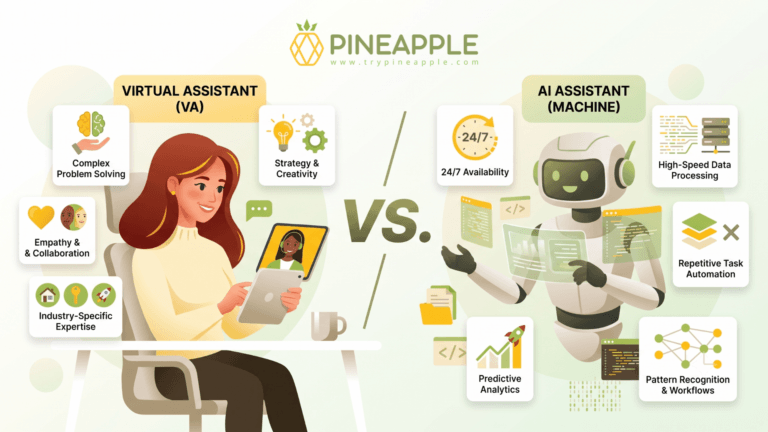
The key differences come down to human expertise versus artificial intelligence and automation.
- Human VAs are skilled remote professionals who perform tasks with contextual understanding, human judgment, and personal accountability. A virtual assistant can manage client relationships and make judgment-based decisions that require strategic thinking and high-level interaction, particularly when you hire a Filipino virtual assistant trained for global clients.
- AI tools are software systems-often powered by generative AI, machine learning, and natural language processing-that automate processes, generate content, and respond to inputs. AI tools process large data amounts and automate repetitive tasks, while virtual assistants provide strategic support and relationship management.
Virtual assistants provide personalized support while AI tools are designed for data processing and task automation at scale. AI tools are moving toward autonomous action, with AI agents that can operate independently after an initial prompt and execute complex workflows across different systems. Meanwhile, human agents handle unpredictable situations, nuanced client communications, and complex decision making that AI systems still struggle with.
Both approaches serve different business needs. Using both AI tools and virtual assistants simultaneously is an effective strategy for management-AI handles the volume, humans handle the value, and understanding the right time to hire a virtual assistant helps you sequence those investments effectively.
Cost and Budget Considerations
Cost is often the first factor businesses evaluate, but surface-level pricing comparisons miss the full picture.
Transparent pricing models differ sharply between the two. Human VAs like Pineapple’s start at $8/hour with no contracts or setup fees. AI tool subscription fees range from $29 to $200+ per month, with usage-based charges that can spike unpredictably.
Hidden costs exist on both sides. AI tools require ongoing management, prompt engineering, and output review. According to Tom’s Hardware, AI subscription costs are hitting pricing walls, with tiers like Claude Max 20× ($200/month) masking far greater underlying token costs when used heavily. Human VAs require onboarding time but deliver increasing value as they learn your business, especially with providers that emphasize transparent virtual assistant pricing and processes.
Scalability also differs. AI tools can run multiple tasks simultaneously without human intervention, scaling parallel workflows rapidly. But VAs can handle increasing complexity-multi step tasks, context switching, and judgment calls-where AI tools hit capability limits, which helps explain the rise in demand for virtual assistant agencies. The ROI calculus shifts depending on whether you need volume or depth.
Human Virtual Assistant Costs
Pineapple offers transparent $8/hour pricing with no setup fees or contracts, making a virtual executive assistant for business growth accessible at a fraction of typical U.S. rates. That positions it competitively within the offshore generalist range of $7–$15/hour, while U.S.-based specialized VAs typically cost $30–$75+/hour.
Human VAs provide predictable costs with increasing value over time. As your VA learns your brand voice, processes, and preferences, the cost per completed task actually decreases because less instruction and revision is needed. A full-time dedicated VA at $8/hour runs approximately $1,280/month for 160 hours-significantly lower than U.S.-based alternatives at $4,000–$8,000+/month.
The real comparison is cost per completed task vs cost per hour worked. A VA who understands your business completes tasks faster and with fewer errors than one who’s just starting.
AI Tool Costs
AI productivity tools use several pricing models: subscription fees (Copy.ai starting around $29/month, Jasper at $59–$69/month per seat), API costs based on token usage, and credit-based systems where different actions consume different credit types.
Factor in the training time for prompt optimization, the ongoing management overhead of reviewing AI output, and the cost of correcting mistakes. A recent study on ScienceDirect found that while AI models can exceed humans on some divergent thinking tests, they significantly underperform on associative thinking, creative evaluation, and selecting ideas where novelty must balance appropriateness-meaning human quality assurance is still essential for any output that matters.
The true cost of AI powered tools often exceeds the subscription price once you account for human input needed to verify, edit, and correct automated workflows.
Capabilities and Task Complexity
Each solution handles different task types best. Routine automation vs complex judgment-based work requires fundamentally different capabilities, and businesses can choose from different types of virtual assistants to align human support with those needs.
AI agents excel at pattern recognition, processing real time data, and executing predefined tasks at speed. Humans excel at understanding context and complex emotional intelligence-reading between the lines, navigating ambiguity, and making judgment calls that require weighing competing priorities.
AI agents can adapt to user behavior in real time and manage multiple tasks simultaneously without human intervention. But AI virtual assistants use natural language processing for interaction that remains literal and pattern-based. AI chatbots handle simple, repetitive tasks through scripted conversations and typically rely on predefined flows or decision trees. Virtual assistants use advanced NLP to understand user intent and can maintain context across multiple interactions-a critical difference for ongoing project management and client work.
Accountability matters too. When a human VA makes a mistake, they can explain what happened, learn from feedback, and take ownership. When AI systems produce errors-hallucinations, misinterpretations, confidently wrong outputs-the responsibility falls entirely on the user.
What Virtual Assistants Excel At
Virtual assistants are ideal for tasks requiring strategic thinking and high-level interaction: complex project management, client relationship building, and strategic decision support.
Pineapple’s specialized Business VAs handle data entry, calendar management, lead capture, and task management across multiple systems. Multimedia VAs bring aesthetic judgment to video editing, graphic design, and brand consistency. Legal VAs understand jurisdictional requirements, citation norms, and procedural nuance that AI simply cannot replicate reliably, reflecting the essential virtual assistant roles Pineapple offers businesses.
Human VAs provide contextual understanding and adaptive problem-solving. They can interpret unclear instructions, anticipate needs based on past interactions, and adjust their approach based on feedback-learning continuously rather than requiring reconfiguration.
What AI Tools Excel At
AI is suitable for high-volume routine and data-intensive tasks. AI agents can manage multiple tasks simultaneously without human input, processing large datasets, generating content drafts, and monitoring inboxes at all hours.
AI virtual assistants improve customer experience with 24/7 support, enhancing customer service availability outside business hours. They can automate patient intake in healthcare settings, integrate with CRMs and project management tools, and execute automated workflows across different platforms, while human support can be added later through a quick tell us your virtual assistant needs assessment.
For straightforward tasks-scheduling, reminders, data analysis, template-based content-AI powered tools reduce manual effort significantly. AI tools can streamline workflows, leading to faster decision-making on predefined tasks. AI assistants provide 24/7 customer support and can answer questions instantly through conversational AI. Speed advantages are clear for repetitive, rule-based work that doesn’t require the human touch.
Availability and Reliability
AI tools offer 24/7 availability with instant responses-no sleep, no timezone gaps, no vacation. For time-sensitive monitoring, alert triage, and after-hours customer facing support, this is a genuine advantage. AI virtual assistants can reduce employee workload by handling simple tasks during off-hours.
Human VAs work structured schedules, which means timezone coordination and coverage gaps. However, virtual assistant providers can offer backup or replacement VAs to ensure continuity. The support quality difference is significant: AI delivers automated responses that can be confidently wrong, while human VAs offer personalized communication that adjusts to a client’s mood, style, and unspoken expectations.
Consistency cuts both ways. AI outputs are predictable and repeatable-useful for predefined tasks. But human creativity and judgment vary in ways that add value. Some customers prefer human interaction for customer service over AI tools, especially in sensitive fields like legal services, healthcare, or high-stakes business relationships, where understanding the tradeoffs between a legal assistant vs legal virtual assistant becomes particularly important.
When system failures occur, AI tools require technical redundancy and fallback modes. When a human VA is unavailable, providers like Pineapple can match you with a replacement who picks up the context-something no AI system can fully replicate when relational memory and business knowledge are lost.
Communication and Relationship Management
AI’s literal interpretation contrasts sharply with human understanding of context and nuance. AI bots process natural language understanding at a surface level-they can parse words but miss undertones, irony, cultural cues, and the unspoken expectations that shape effective relationship management.
Virtual assistants can maintain context across multiple interactions and build on previous interactions to deepen client relationships. They adjust communication style over time, exercise emotional intelligence, and navigate conflict with diplomacy. This human touch is irreplaceable for client communications where trust, persuasion, and cultural sensitivity matter.
Feedback loops differ fundamentally. Humans respond to critique and adjust future behavior continuously. AI tools require reconfiguration, prompt re-engineering, or model updates-and mistakes may repeat until someone identifies and fixes the underlying issue. Chatbots typically rely on predefined scripts or decision trees that don’t evolve through natural conversation.
For small businesses where every client relationship directly impacts revenue, the ability to build genuine personal connections through a dedicated virtual assistant often delivers more value than any ai automation could.
Setup and Management Requirements
Onboarding processes differ significantly between the two solutions.
AI tool configuration involves connecting APIs, setting up automated workflows, integrating with calendars, email, databases, and external tools. Basic setup is often faster-many tools work out of the box for simple tasks. But configuring AI solutions for specific tasks requires prompt optimization, automation rules, and ongoing testing. AI virtual assistants can integrate with CRMs and project management tools, but the technical integration can be complex.
VA training and integration requires initial hours (typically 10–40+) to familiarize the assistant with your tools, brand voice, standard operating procedures, and specific task requirements. Pineapple reduces this friction with no setup fees and flexible engagement-you can scale hours up or down without long-term commitments thanks to a simple how it works virtual assistant onboarding process.
Ongoing management also differs. AI tools need continuous monitoring for output quality, hallucination detection, prompt drift, and usage cost tracking. Human VAs benefit from periodic feedback and performance reviews, but the investment decreases as they internalize your processes. You can monitor VA productivity through established workflows rather than debugging software, especially when partnering with a provider focused on where to hire virtual assistants in the Philippines and ongoing performance support.
Quality control for AI output typically requires human review-especially for legal, compliance, or brand-voice content. With human VAs, quality assurance is collaborative: you review, provide feedback, and the VA improves. AI tools can automate routine tasks and improve overall efficiency, but human intervention remains necessary to catch errors that AI models cannot self-identify.
Virtual Assistants vs AI Tools: Which Should You Choose?
Choose human virtual assistants for relationship-driven tasks, complex project ownership, and strategic business support. When work requires human judgment, cultural sensitivity, multi step processes, or accountability, no AI solution matches what a skilled human professional delivers.
Select AI tools for high-volume automation, data processing, and 24/7 monitoring requirements. When you need to complete tasks at scale-data entry, scheduling, content drafts, automated responses-the right AI tool can save time and reduce manual processes significantly.
Consider Pineapple’s virtual assistants for transparent pricing, no-contract flexibility, and specialized expertise across business, multimedia, and legal tasks. At $8/hour with no setup fees, Pineapple offers the lowest barrier to entry among quality VA providers-well below the $25–$75/hour range of U.S.-based alternatives-while delivering the human expertise, relationship management, and accountability that AI tools simply cannot replicate. Pineapple’s VAs are the best choice because they combine cost transparency, domain specialization, and the flexibility to scale without contracts, giving businesses benefit at every stage of growth.
The smartest approach for most businesses combines both: use AI tools to automate routine tasks and handle straightforward tasks at volume, then allocate your human VA’s time to oversight, refinement, complex workflows, and the high-impact work that drives real business results. AI can reduce manual effort on predefined tasks. Humans ensure that everything customer-facing, strategic, or high-stakes meets the standard your business demands.
Both virtual assistants and AI tools can deliver strong results when matched with the right tasks and managed effectively.